
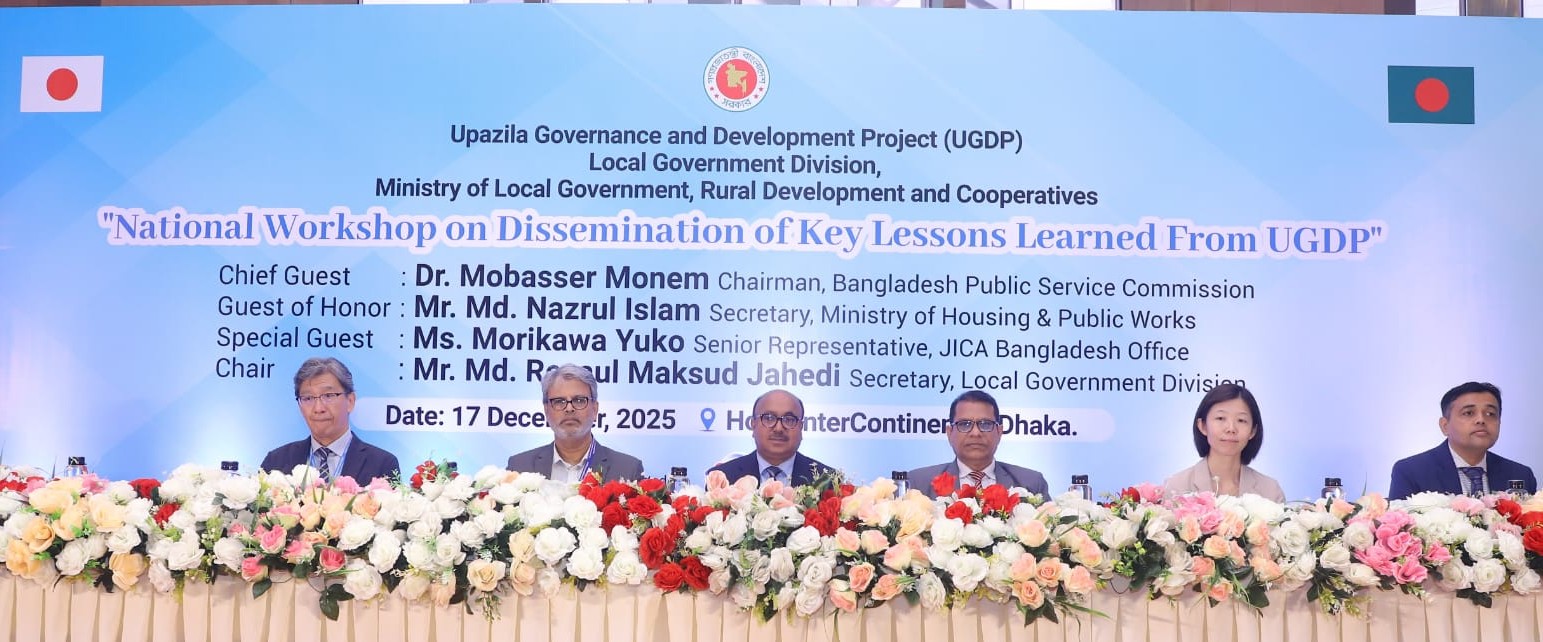
Staff Reporter : The Japan International Cooperation Agency (JICA) Bangladesh hosted a dissemination workshop today to showcase the achievements of the Upazila Governance and Development Project (UGDP) and outline strategies for strengthening local governance in Bangladesh.

The event was graced by Dr. Mobasser Monem, Chairman, Bangladesh Public Service Commission, as Chief Guest. Mr. Md. Nazrul Islam, Secretary, Ministry of Housing & Public Works, attended as Guest of Honor, while Ms. Morikawa Yuko, Senior Representative, JICA Bangladesh Office, joined as Special Guest. The program was chaired by Mr. Md. Rezaul Maksud Jahedi, Secretary, Local Government Division, and coordinated by Dr. Abu Nasar Mohammad Abdullah, Joint Secretary & Project Director, UGDP.
UGDP, implemented nationwide, introduced performance-based financing, digital governance tools, and capacity development initiatives to empower Upazila Parishads as key institutions for grassroots service delivery. The workshop brought together policymakers, development partners, and local government representatives to reflect progress and persistent challenges in achieving SMART governance—Strategic, Measurable, Accountable, Responsive, and Technology-enabled.
Key Achievements UGDP is driving innovation to build a sustainable model for local development. Key accomplishments presented at the event include the rollout of Performance-Based Allocation (PBA), a groundbreaking approach that ties financial initiatives to governance outcomes,

encouraging accountability and positive behavioral change. The project has also advanced Digital Innovation, introducing web-based governance performance assessment that has significantly boosted transparency and operational efficiency in local government operations. In addition, Inclusive Capacity Development initiatives have delivered training programs targeted towards upazilla officials. Local women and youth were also central to capacity development efforts for better livelihoods and income generation.
Lessons Learned
The workshop highlighted critical insights from UGDP’s implementation experience. It reaffirmed that financial incentive is a powerful tool to drive reform and improve accountability. The sustainability of these reforms depends on institutionalization, while strong leadership and effective coordination amplify the impact. Additionally, continuous capacity development remains the foundation for robust governance systems. Additionally, while digital governance enhances transparency, a hybrid oversight approach ensures optimal results.
The event highlighted JICA’s continued commitment to supporting Bangladesh in mainstreaming UGDP’s innovations into national systems. Sustaining progress will require institutionalizing performance-based financing, embedding digital systems, and advancing inclusive reforms for resilient local development.