
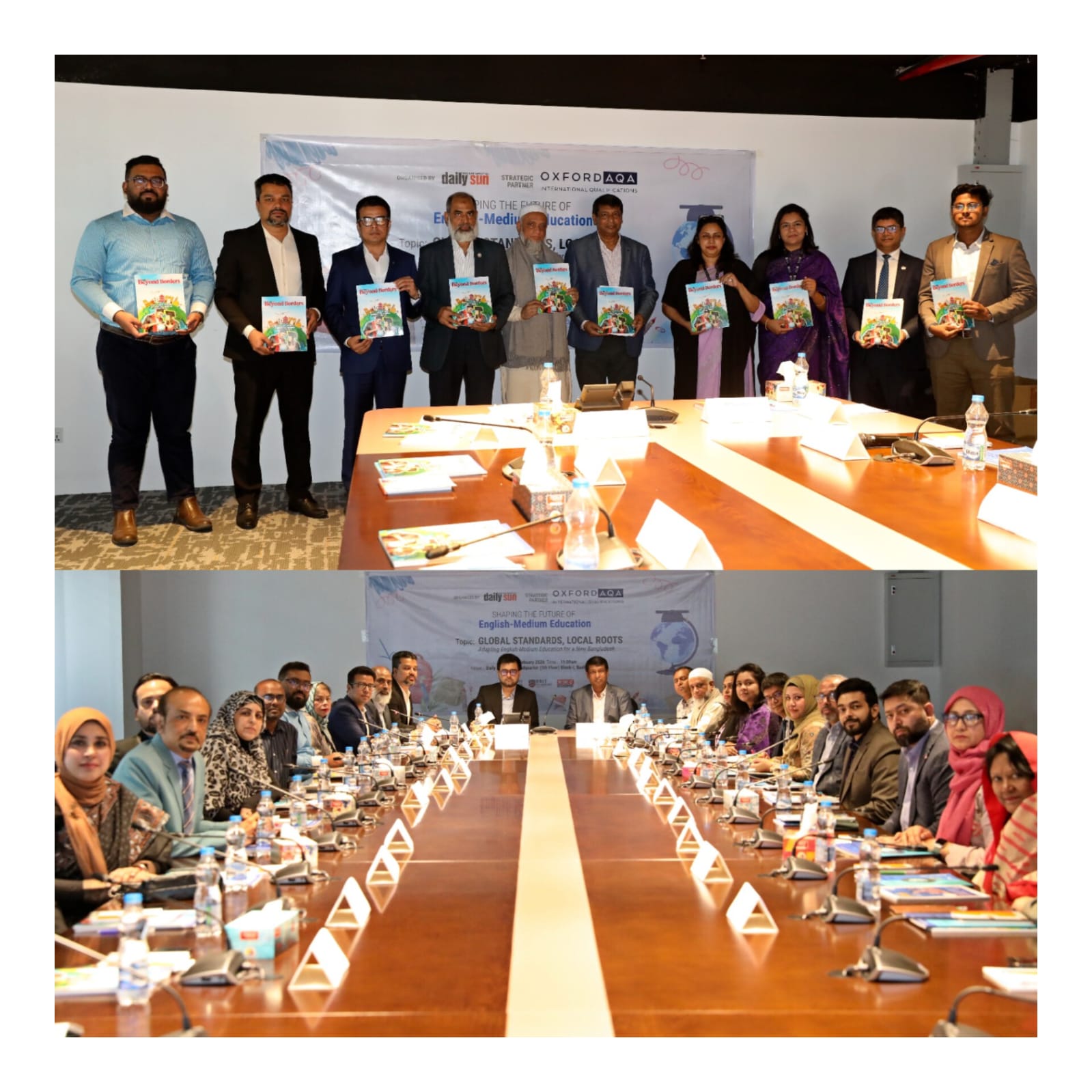
Staff Reporter : English medium schools have expressed their expectation for enhanced cooperation and greater recognition from the government, especially in the university admission process, recognition of their international achievements, and various educational policy issues.

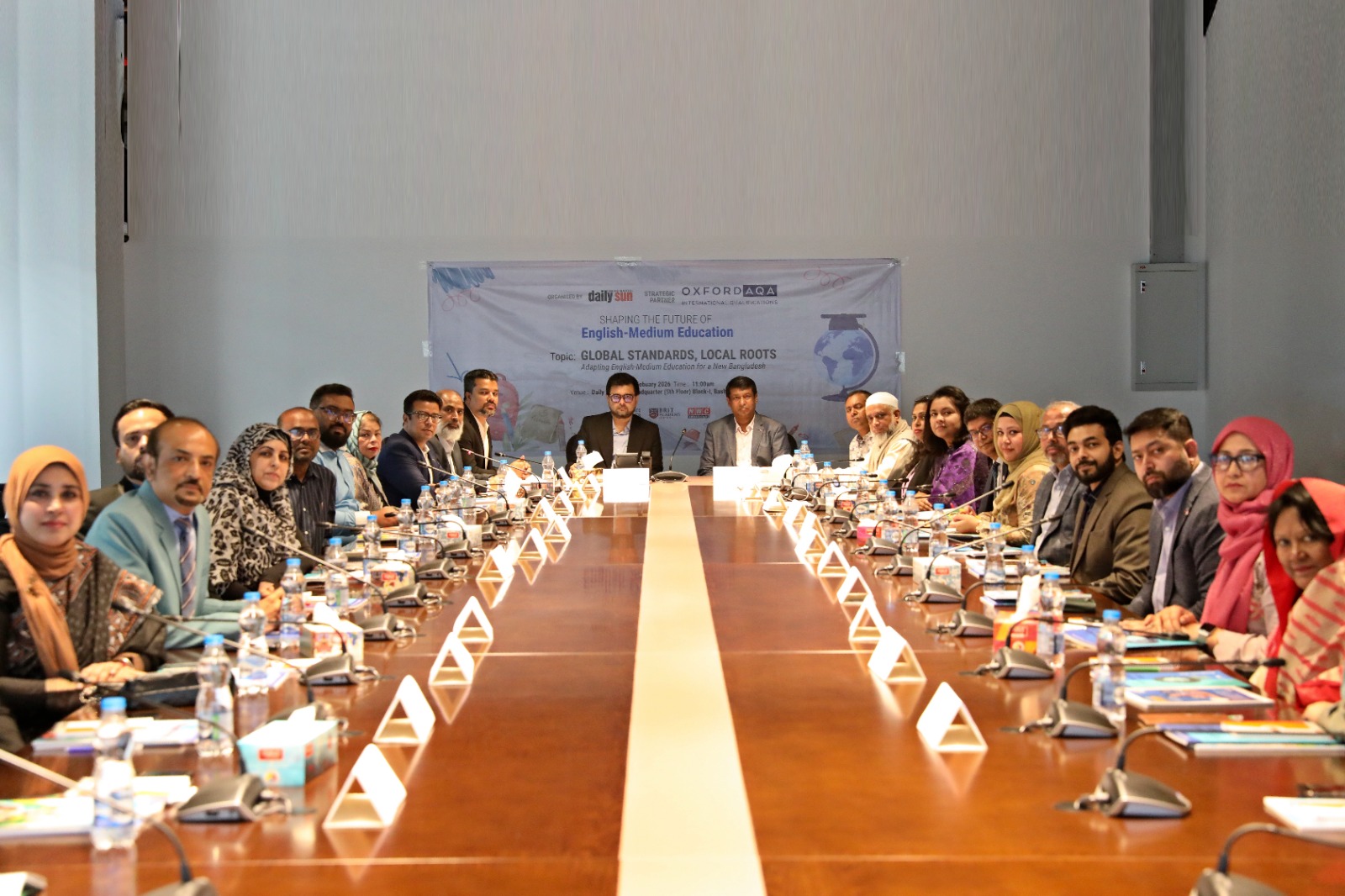
The principals and representatives of the country’s leading English medium schools came up with these demands in a roundtable at the conference room of the Safwan Bashundhara Global in the Bashundhara Residential Area on the backdrop of facing accusations of non-compliance with government policies and various negative criticisms from government officials and others.
was English-Medium Education for a New Bangladesh’, which was organised by the Daily Sun in collaboration with the International Examination Board OxfordAQA, education consultancy NWC, and Brit Academy London.
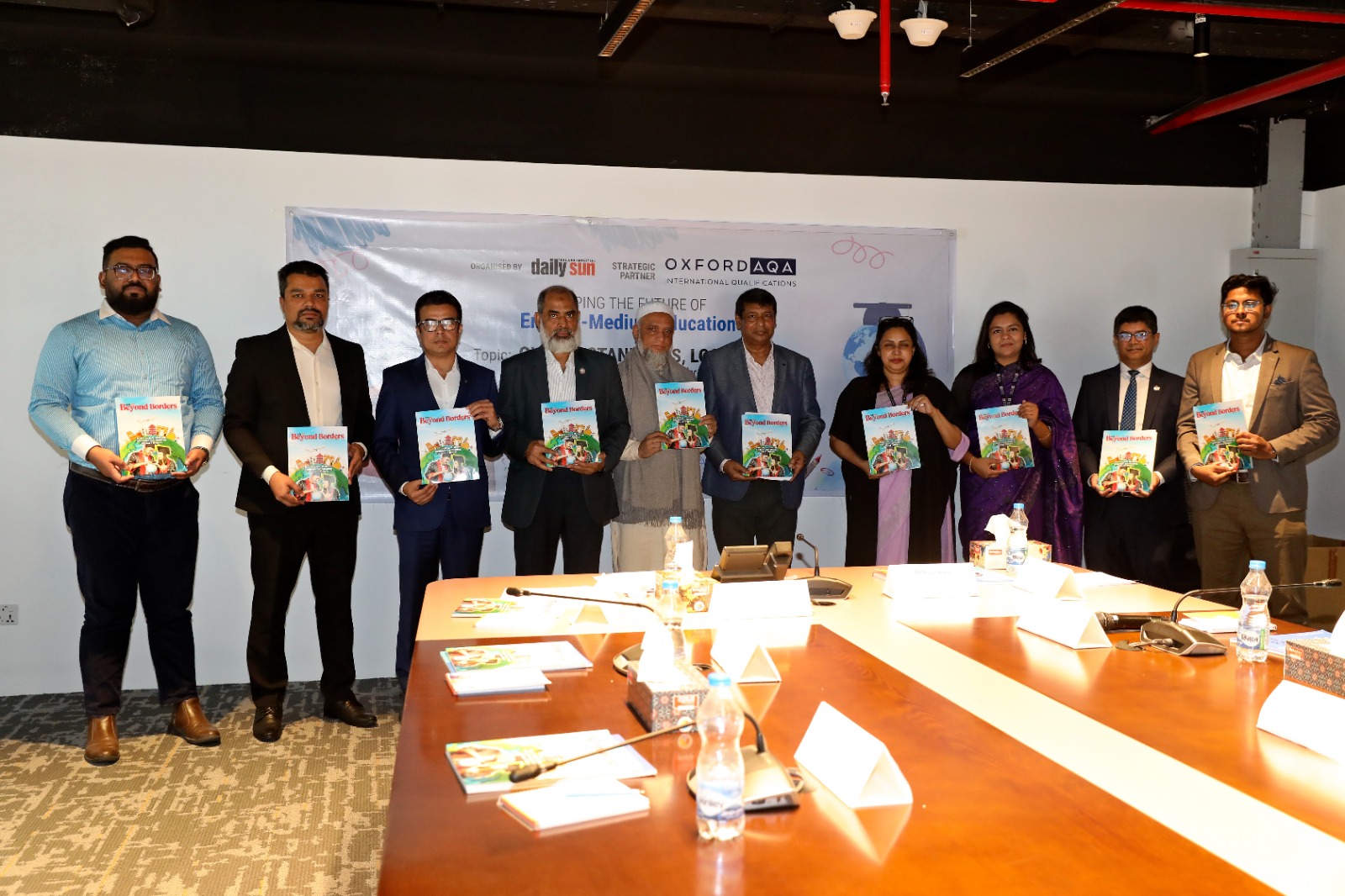
The event witnessed the official launch of “Beyond Borders”, a magazine dedicated to English-medium and higher education. This publication will provide students, parents, and education stakeholders with international opportunities, guidance, and research-based information.

Explaining the context of arranging the roundtable discussion, Daily Sun Editor Rezaul Karim Lotus, in his welcome address, said the English-medium sector in Bangladesh has often been viewed as a separate stream, operating in a parallel lane to the national discourse, though it has been a quiet powerhouse—producing world-class talent, fostering global mindsets, and acting as our primary link to the international academic community.

বিজ্ঞাপন
Terming the roundtable a collaborative workshop, instead of more than just a conversation, he said, “We are not just talking about academic excellence in a vacuum. We are talking about how we can take the rigorous global standards of the British curriculum and ground them deeply into the soil of our motherland.”
“In this ‘New Bangladesh’, our goal is to produce graduates who are as comfortable in a boardroom in London or Silicon Valley as they are contributing to the social and economic fabric of Dhaka, Chattogram, and beyond,” he added.
University Grants Commission Secretary Dr Md Fakhrul Islam said at this event we faced so many problems there with students who passed their O-levels and A-levels from English medium schools, particularly those studying abroad, and we tried to formulate solutions and resolve all the problems through the education board.
“The University Grants Commission receives all the applications, which are processed through my administration. We have an international desk called the ICC—International Cooperation and Collaboration desk. We have a focal point and receive phone calls constantly, and we try to process all the applications.”
Addressing the discussion, United International University (UIU) Vice Chancellor Prof Dr Md Abul Kashem Mia highlighted the lack of opportunities for English medium schools in the country’s higher education sector.
“It is very difficult for English medium students to cope with the public universities as the environment is different there. We try to align with the English-medium education system and environment at private universities. Our students, both from English and Bangla medium backgrounds, have been winning global robotics competitions. They stood first in Asia for the fourth consecutive year and fifth in the world. Apart from core performance, our students from English medium backgrounds are excellent at presentations,” he said.
“We always thank our English-medium schools, as they are doing an excellent job in nurturing and preparing our students with a global standard of education,” Prof Dr Md Abul Kashem Mia added.
Sabrina Shaheed, Principal, Sir John Wilson School, said, ‘We often hear the concern that English medium schools neglect our roots, but I want to clarify that mindset. We teach Bangla from the very beginning of a child’s schooling to ensure linguistic competence. We actively celebrate all national and culturally significant days to keep our traditions alive in the hearts of students.’
“We must integrate our history and geography directly into the curriculum while students are at an age where their opinions and futures are being shaped,” she added.
Before concluding, moderator of the roundtable discussion and Executive Director of the Daily Sun, Tasvir Ul Islam, said, being an alumnus of an English-medium school, he rejects the perception that English-medium students can’t speak in Bangla.
He said they can speak Bengali well, as they celebrate Nababarsha (Bengali New Year), Pahela Falgun (the first day of spring), Ekushey February (International Mother Language Day), 26 March (Independence Day) and 16 December (Victory Day).
“Maybe global standards and local routes are not mutually exclusive to land, but they are the two wings that a student needs to fly and go beyond the sky. So, that is something we would keep in mind,” he said.
In her speech, the British Council’s Director of Business Development, Tahnee Yeasmin, said the British Council works with schools through the delivery of exams and helps connect them globally to ensure their communication and information are proper, respectful, and impactful.
“Beyond exam delivery, the council ensures schools have access to various services, such as safeguarding training to ensure a safe place for study. They also promote Equality, Diversity, and Inclusion (EDI), supporting schools in providing accessibility for students with different interests and abilities,” she said.
Speaking about the British Council’s role in the professional development of English-medium teachers, Tahnee Yeasmin said they provide training to partner teachers.
“We provide them with Continuing Professional Development (CPD) training, as the education system and information are updated daily, and therefore, professionals must continue to learn. The Council provides training so that teachers can run classrooms with the same high-quality support service found in UK schools,” she added.
Operation Manager of Brit Academy London, Sabbir Alam, said one of the biggest challenges students face after completing A-levels is confusion.
“Many students and parents are unsure whether they should apply directly to universities, apply for a foundation group, or explore competitive universities around the world. We focus on providing structured and reliable academic progression pathways. One of the key routes we promote is through NCC Education, which is a UK-regulated body. NCC programmes provide students with a step-by-step academic path to undergraduate degrees in countries such as the UK, Australia, Canada, and across Europe.”
Md Shahin Reza, Country Director, Bangladesh OxfordAQA, said, ‘As an education board, we place a lot of emphasis on those 21st-century skills and competencies.’ For example, we are the largest exam board in the UK—OxfordAQA is a joint venture between AQA and Oxford University Press. These two brands bring a massive amount of experience in managing exams and educational products. AQA is the largest exam board in the UK, with over 140 years of experience in assessment.
“To give you an idea of the scale, about 62% of GCSE exams (equivalent to O-Levels) and almost half of the A-Level exams in the UK are conducted by AQA. That is our expertise and the standard of the certificates we issue,” he added.
Md Wahed Ibne Shahed, VP and Head of Retail Banking, Trust Bank PLC, said education should never be limited by financial barriers. The banking sector in Bangladesh is making real progress in turning obstacles into opportunities. With tailored loans, student banking programmes, digital innovations, and agency partnerships, parents, schools, and students are now better equipped to bridge the gap between their dreams and reality.
Farzana Karim, Principal, Al Azhar International Grammar School, said, “Our students are getting the world highest and nobody talks about that. The government doesn’t even appreciate it. We are compared with Bangla medium national curriculum students. But the students who have got the world highest, what about them? And the teachers who are teaching them are Bangladeshi teachers. And they have come from a Bangla medium background. But they have got the students to get world highest. So teachers also have to be appreciated.”
Panellist discussions featured Fitrat Rasheed, Vice Principal, Hurdco International School; Yasmeen Habib, Principal, Sunnydale School; Abdullah Al Masud, Principal, Green Mind International School (GMIS); Professor Kutub Uddin, Managing Director, Academia; Fayez Ahmed Jahangir Masud, Principal, Legend International School; Abdullah Jaman, Principal, Wheaton International School; Maryam Noor Yunus, Principal, New Horizon Crescent International School.
Amreen Hussain, Vice Principal, Canadian Maple International School; Afroza Hoque Chowdhury, Principal, Stepping-Stone International School; Md. Saeful Seraj Saef, Head of Student Banking, City Bank PLC; Jubair Nayeem, Head of Business Development (Schools), British Council; Mohammad Kanchan, Manager, Brand Marketing, TCL Global.