
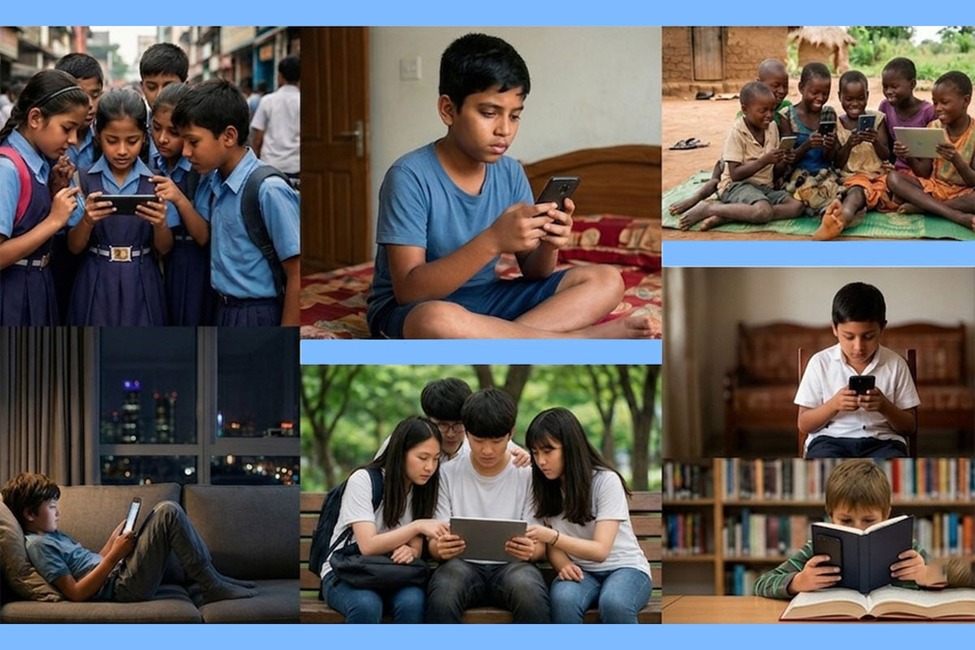
Audite Karim : Our children and adolescents are passing through a terrifying era. Social media is now the biggest obstacle to their development. Instead of books, we are handing smart devices to young children. Children are becoming addicted to mobile phones, gaining unrestricted access to whatever they wish to see.

Instead of studying, their eyes are constantly glued to devices. This is affecting their mental development while causing various physical ailments. In adolescence, mobile usage is leading them toward drug addiction and inciting violence.
Exposure to obscene content on mobile devices involves teens in crimes like stalking (eve-teasing). Influenced by Facebook and TikTok, they are forming “Juvenile Gangs.” Thus, generation after generation is going astray. The bright future of our youth is being destroyed by social media.

We frequently hear news of “Juvenile Gang attacks over establishing dominance.” News of teenagers being killed in such clashes is no longer new. Every attack involves an organized group of at least 30 to 40 teenagers; in some places,

groups of over a hundred are seen. But the question is: how do so many teenagers gather instantly? In search of an answer, terrifying information has emerged! A major reason for the rise in juvenile crime is the misuse of information technology. IT is being used behind every single attack.
They operate through groups on social media platforms like Facebook, Messenger, WhatsApp, or IMO. Consequently, news reaches members across different locations in an instant. This allows them to gather in a short time to carry out attacks, vandalism, and even murder.
Social media has become an open and unregulated platform. The behaviors and activities found there are harmful to the safety and welfare of children. Alongside the risks of fraud and harassment, children fall victim to online bullying.
Another concern regarding the unrestricted use of social media is excessive screen time. Of particular concern is that these apps are designed with personal algorithms to maximize user attention. As a result, users of all ages are forced to spend long hours on devices. For students, this leads to poor academic results, sleep deprivation, and reduced social interaction.
This problem is not unique to Bangladesh; social media is now the most dangerous path for children worldwide. Because of this, several countries have restricted or banned the use of platforms like Facebook, TikTok, and YouTube for minors.
Countries including the UK, Australia, France, Denmark, Spain, and Norway have announced restrictions. On December 10 last year, Australia became the first country in the world to ban social media for those under 16. The UK is also considering such a ban. On January 21, the House of Lords voted in favor of banning social media for children under 16, putting significant pressure on Prime Minister Keir Starmer’s government to be as strict as Australia. Meanwhile, France and Denmark have announced restrictions for those under 15.
Norway has admitted that current restrictions are not working and is developing more effective monitoring systems. China enforces some of the strictest digital controls, limiting screen time to 40 minutes for children under 14 and completely blocking digital access from 10 PM to 6 AM.
In the United States, lawsuits have been filed against Facebook, TikTok, and YouTube for causing mental harm to children. A lawsuit filed in Los Angeles on January 26 accuses Meta, Alphabet, and ByteDance of addicting children and damaging their mental health. The lawsuit claims platforms are designed to trap attention and promote harmful content. Plaintiffs argue that the companies developed algorithms specifically to addict children.
These global initiatives highlight that the entire responsibility for the damage caused by social media cannot be placed solely on parents. The social media platforms that earn billions by capturing children’s attention must also bear the burden of this damage.
It was once thought that parental supervision was enough, but governments in Australia, the UK, France, Norway, and Turkey now argue that supervision alone is insufficient. This does not mean parents or governments are absolved of duty—the family is essential for protection, as is the state. However, it is now clear that social media companies cannot evade responsibility for online safety.
Many parents in our country hand over phones to fulfill a child’s whim or to stop them from “being annoying.” Often, when it becomes difficult to feed them, the phone is used as a “shortcut” solution. While this may be a temporary fix, it creates a severe addiction, trapping the child in a web from which it is difficult to escape. This digital world is as dangerous as it is attractive. Anxiety, depression, sleep disorders, and addiction are no longer isolated incidents. The question is: who is responsible? It is unrealistic to leave parents to stand alone. How can a family compete against a trillion-dollar algorithm?
While the rest of the world is taking strict measures, Bangladesh remains largely indifferent. Recent police data suggests social media is a primary cause of rising juvenile crime. Research by a development organization working on child marriage shows that social media has contributed to an increase in child marriages. Another study indicates rising sexual harassment against women and girls due to social media. Blackmailing through obscene videos after trapping teenagers in “romance traps” has increased alarmingly. Analysis of media reports shows that last year alone, at least 209 suicides occurred due to social media-related issues. Our children’s habit of reading books has declined, and their concentration is shattered. Social media is constantly draining the vitality of our youth.
The more we ignore this, the deeper the problem will become. Without a moment’s delay, social media must be brought under regulation. This should be one of the government’s top priorities.
Audite Karim: Writer and Playwright Email: auditekarim@gmail.com