
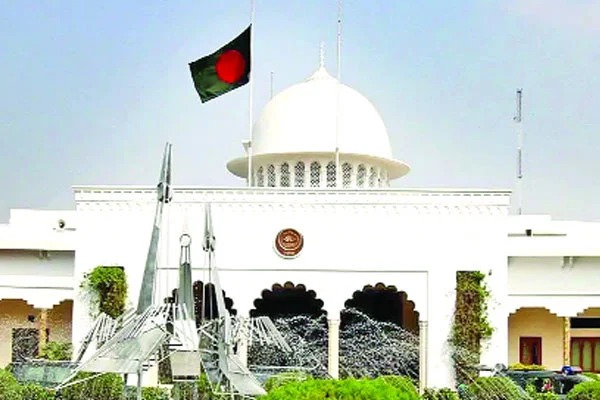
Staff Reporter : Bangladesh is currently awaiting a new president. Following the resignation of Mohammed Shahabuddin on 24 July, Speaker Maj (retd) Hafiz Uddin Ahmad has been serving as the acting President. A new president will be elected by the national parliament within the next 90 days. Since the Bangladesh Nationalist Party (BNP) holds an absolute majority in Parliament, whoever the ruling party nominates will become the next president. The BNP has said it will make a final decision after discussions within its Standing Committee. The law minister has stated that the formalities for the presidential election will be completed during the next session of Parliament. On Tuesday, the Election Commission initiated the formal election process after holding a meeting with the acting speaker.
According to the Constitution of Bangladesh, the president is the first citizen of the country. Article 48(2) states that the president shall take precedence over all other persons in the Republic.
In the history of Bangladesh’s parliamentary democracy, the office of the head of state has never been particularly powerful or prestigious. Since the leader of parliament serves as the chief executive of the government, the presidency has remained largely ceremonial. Under the current Constitution, the president’s powers are extremely limited. Article 48(3) provides that the president must act in accordance with the advice of the prime minister in all matters except the appointment of the prime minister and the chief justice. Even in these two areas, no president has exercised unilateral discretion to date. Justice Md Shahabuddin Ahmed, the head of Bangladesh’s first caretaker government and a former president, once remarked jokingly that the president had little to do other than visit graves. From delivering speeches in Parliament to carrying out every other constitutional duty, the president is expected to act in line with the government’s decisions and directives. Although the constitution appears to reduce the president to a ceremonial figure, the office carries certain inherent responsibilities and moral authority. A closer reading of the Constitution suggests that the president is not merely a figurehead but also the guardian of the nation and the symbol of state unity and solidarity. During major national crises or constitutional deadlocks, the presidency can become a stabilising force. The office serves as a constitutional safeguard, helping to uphold democratic principles and constitutional values. Therefore, while the formal powers of the president may appear limited, the office itself carries considerable influence. A strong, responsible and dignified individual can, through personal stature and integrity, become a true guardian and guide for the nation.

For this reason, we do not want an obedient flatterer as president – someone who, despite occupying the highest constitutional office, is remembered only as a loyal and spineless sycophant. We want a principled leader and a person of integrity – someone who commands respect and is acceptable across political divides.
This year’s presidential election is particularly significant for several reasons. The non-partisan caretaker government system has returned. According to the verdict of the highest court, the next parliamentary election will be held under a caretaker government. The process of transferring power from an elected government to a caretaker administration is highly sensitive and complex. Political tensions and divisions often intensify during such periods, increasing the risk of confrontation. If the presidency is held by a firm, strong-willed and dignified individual, navigating such crises becomes considerably easier. Political parties can engage with a president who enjoys broad acceptability, creating opportunities to resolve disputes through dialogue and consensus. For that reason, the office of the president assumes exceptional importance at this moment.

A second reason is that, during discussions with the National Consensus Commission, almost all political parties proposed increasing the president’s powers. In April last year, the BNP also agreed in the Commission to establish a greater balance of power between the president and the prime minister. The ruling party is expected to table a constitutional amendment bill in the upcoming session of Parliament. If the Constitution is amended, the president’s authority will inevitably expand. The office will involve far more than merely “visiting graves”; it will require independent judgement on several critical matters. Consequently, appointing an experienced, prudent and responsible individual to the presidency has become even more important.
As ordinary citizens, we want a genuine guardian as our president. We do not want the office to become a consolation prize that offers someone a life of comfort and privilege at Bangabhaban. We want a president who regards the office as a sacred constitutional responsibility – someone who remains constantly vigilant in defending constitutional order and democratic values. Nor do we want a president who treats the office as an opportunity for personal prestige, travelling at home and abroad at taxpayers’ expense without accountability.
We want a principled political figure as president – someone who is wise, respected and possesses an established public reputation. The people do not want a nominee whose name leaves the nation wondering who they are. Nor do they want an obscure individual who is as surprised as everyone else to find themselves chosen for the country’s highest constitutional office.
The people want a president whose credibility extends beyond party lines – someone who has earned the position through merit rather than receiving it as a reward for unquestioning loyalty. The presidency should never become a prize for hidden allegiance or political patronage.
The public wants an honest, principled and uncontroversial individual in the highest constitutional office. It does not want someone whose integrity is in doubt or whose past is clouded by allegations of controversial conduct. Such individuals are best left out of consideration. Let the next head of state be someone in whom all citizens can place their trust – someone who will act fearlessly in defence of the people and the Republic, rising above partisan interests. Such a president should never sacrifice democracy for self-preservation under pressure from anti-democratic forces, nor yield to unconstitutional interference or injustice.
The people no longer want an apolitical, detached member of the civil society class in this office. They have seen how some such figures, once in power, become detached from the public interest and fail to protect citizens’ rights. Instead, the people want a politician who has earned public trust through years of grassroots political engagement – someone who remains accountable to the people and to democracy, who has consistently fought for the rule of law and justice, and whose sacrifices in the struggle for democracy are widely recognised.
Under the leadership of Tarique Rahman, the BNP has weathered many political challenges before assuming responsibility for governing the country. The Prime Minister has surely not forgotten the bitter lessons of the past concerning the presidency. Few understand better than the BNP how a spineless “yes-man” can diminish the dignity of such a high office. History has repeatedly shown the consequences of elevating individuals beyond their merit. Such opportunistic flatterers are dangerous not only to political parties but also to the people and the democratic system itself.
The expectation is that the BNP will take the necessary time, carefully weigh the national interest and select a worthy candidate. Bangladesh has no shortage of capable and deserving individuals.