
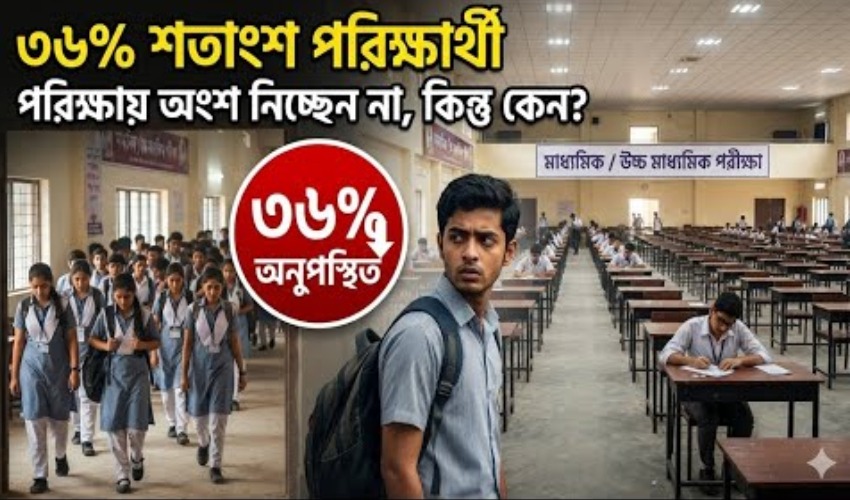
Staff Reporter : This year, 36% of regular students are not participating in the Higher Secondary Certificate (HSC) and equivalent examinations. Every year, many students who register for public exams like the SSC and HSC ultimately do not sit for the exams. However, education stakeholders believe that the rate of non-participation this year is abnormally high.

The HSC and equivalent examinations began last Thursday, 2 July. According to information from the Ministry of Education and education boards, under the 11 education boards, about 1.5 million students passed the SSC and equivalent examinations two years ago (academic year 2024-25) and registered for Class XI. Among them, about 950,000 students filled out forms for this year’s HSC and equivalent examinations. This means that about 550,000 regular students are not taking the exam.
The higher secondary level is the gateway to higher education. Students who pass higher secondary get the opportunity for higher education. Therefore, this education is extremely important for employment, merit development, and building an educated populace in the country. Thus, this massive amount of dropouts at the higher secondary level is an alarming sign not only for the country’s education system but also for its overall development.

This downward trend in education existed last year as well. Last year, the non-participation rate among regular students in the HSC and equivalent exams was slightly over 29%. In other words, within a span of one year, the rate has increased by nearly 7 percentage points. Last year, more than 425,000 registered students did not take the exam. This indicates a consistently growing reluctance to enter higher education.

The picture of the Bangladesh Technical Education Board is even more alarming. This year, more than 54% of regular students under this board did not even fill out the forms for the examination.
Not just in higher education, but dropouts have increased at an alarming rate across all levels, from primary to secondary. A survey revealed that over the last two years, nearly 60% of primary school students in rural areas do not attend school regularly.
Most of the government secondary schools in the country are struggling due to a shortage of teachers. Additionally, the post of headmaster is vacant in many schools. There are 383 vacant posts for headmasters in government secondary schools, which is about 55% of the total government secondary schools. In some schools, the post of headmaster has not even been created yet.
At the same time, because important administrative positions have been vacant for a long time, school management and supervision have also weakened. According to education experts, ensuring quality secondary education in this situation is difficult.
According to data from the Bangladesh Bureau of Educational Information and Statistics (BANBEIS), secondary level education is currently provided in more than 20,000 schools across the country.
There are currently 702 government secondary schools in the country. The number of approved posts for assistant teachers in these schools is 15,293. Out of these, 2,842 posts are vacant, meaning more than 18% of the posts lack teachers.
Overall, our education system is in a shambles. Education is the core foundation of a state. If a country cannot achieve global standards in education, then development for that country is impossible—a mere delusion.
The current government has made various commitments to improve the quality of education. The BNP government emphasised the education sector in its election manifesto. The manifesto stated that they would build a country’s education system that is modern, work-oriented, production-oriented, and up-to-date. Emphasis will be placed on all levels of education, though primary education will receive the most attention. The budget allocation for the education sector will be step-by-step elevated to 5% of the GDP (Gross Domestic Product).
Meanwhile, in the current 2026-27 fiscal year budget, Finance Minister Amir Khosru Mahmud Chowdhury has increased the allocation for the education sector to 2% of the GDP. A total allocation of 136,606 crore BDT has been made. The allocation has increased by 49,400 crore BDT compared to the previous year.
In his budget speech, Finance Minister Amir Khosru Mahmud Chowdhury said, “In this budget, we have considered education and human resource development as the ‘nucleus’ (the core center) of national progress.”
But merely increasing budget allocation cannot stop this decline in education.
To develop education, we must first go to the root of the problem. We must find the real reason why our education has become diseased and dilapidated. Over the last two years, students’ interest in gaining money has increased much more than their interest in gaining knowledge.
Why is there such a trend ? The reason for today’s chaotic state of our education is a planned conspiracy to destroy education during the tenure of the Yunus-led interim government. In the July movement of 2024, the students of this country played an extraordinary role.
Not just university students, but school, college, madrasa, and even primary school students took to the streets to demand their rights. Naturally, a chaotic situation arose in the country’s educational institutions after 5 August 2024.
This happens in all countries across the world following a mass uprising. One of the main tasks of a post-uprising government is to return students to the classroom. This happened in Egypt after the Arab Spring, when the youth leading the movement took special initiatives to bring students back to classes. Following the mass uprising in Sri Lanka, the first programme undertaken by the new
government upon taking charge was named “Back to Class.” The head of Sri Lanka’s interim government said in his very first speech that if students did not return to classrooms, Sri Lanka would be destroyed. The same thing happened in Nepal.
But in Bangladesh, the complete opposite happened after the 2024 mass uprising. Upon taking power, Yunus did not bring education back to educational institutions; instead, he made students advisors. Instead of teaching in educational institutions, the primary lessons of mob violence began.
The educational institutions were the breeding ground for the mob violence that spread across the country during the Yunus government’s tenure. A section of students left the classrooms and went to the secretariat, public and private offices, and even various business establishments, starting extortion and various forms of trading.
These students seemed to suddenly find a shortcut to becoming wealthy. Some started tender business, while others focused on filing litigations for profit. Instead of attending classes, they went out in groups to the secretariat or some office. Yunus was at the peak of his popularity at that time. People of the country believed whatever he said. The student leaders of that time made him the Chief Advisor.
Therefore, the students had full trust in him. But Yunus never once told the students, “Enough is enough, now go back to class.” Rather, when young students besieged the secretariat demanding “auto-pass,” Yunus accepted their illogical demands. This was a turning point in the destruction of Bangladesh’s education.
Since the Yunus government took responsibility, a “mob festival” began across the country. Even the teachers, the makers of human beings, did not escape from this. Under the guise of corruption allegations and labeling them as cronies of autocracy, innocent teachers were insulted, humiliated, and subjected to physical and mental harassment. They were forced to sign resignation letters and were then driven out of their educational institutions after being disgraced.
Their salaries and allowances were also stopped. Persecution was carried out against their families as well.
In this way, the festival of destroying the country’s education system went on across the country for a year and a half. Dr. Yunus used a section of students as henchmen to retain his power. These individuals now prefer money over the pages of books. Overnight, they have become owners of houses, cars, and immense wealth.
A significant number of students in higher education institutions now think that spending time on political parties is more profitable than wasting time in the classroom. Many believe that lobbying is more important than preparing for a semester. In this manner, higher education today is on the brink of destruction. Studies in the country’s public universities have almost stopped. One faction of teachers is intoxicated with factionalism and the obsession with occupying various posts.
The other faction is either absconding or silent out of fear of the mob. If this is the state of higher education, the condition of primary and secondary education can easily be guessed.
Education has suffered the most damage in the country over the last two years. For this reason, saving education is now one of the major challenges for this government.
To save education, merely increasing investment will not be enough. The educational environment must be brought back to educational institutions. The student-teacher relationship must be strengthened. The culture of respect and honor for teachers must be restored. And that must be done very quickly. Education must be saved. Because if education does not survive, the country will not survive.