
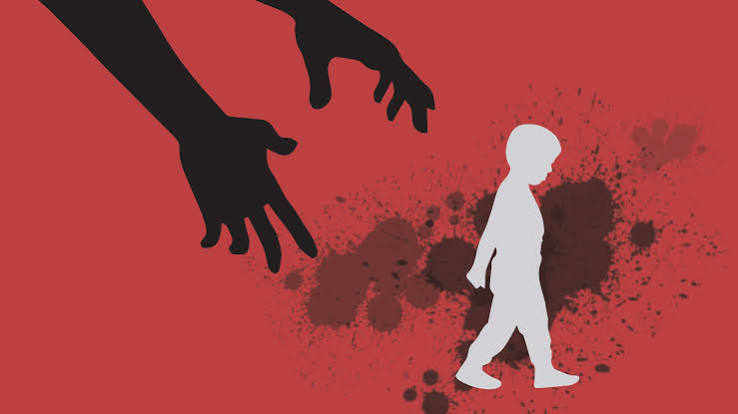
Staff Reporter : A disturbing video depicting child abuse in Qawmi madrasahs in Bangladesh was recently highlighted in a viral social media reel. In this six-minute video, a Qawmi madrasah teacher is seen brutally beating young, innocent children.
The monstrous manner in which he inflicts merciless cruelty upon these children is unimaginable in a healthy society. The individual venting his rage so savagely on helpless children stands accused of a grave criminal offence. He is a disgrace to the teaching profession and can only be compared to a violent, unhinged monster.
This act of brutality against students in Qawmi madrasahs is not an isolated incident in Bangladesh. A closer look reveals that child abuse under the guise of discipline occurs daily in most Qawmi madrasahs across the country. Almost all of us are aware of these incidents to varying degrees, yet no one protests. Physical and mental abuse is inflicted on children right under the nose of the administration.
In many madrasahs, innocent children fall victim to the twisted sexual desires of certain individuals posing as teachers. Child sodomy, sexual abuse and harassment have now become normalised in these Qawmi madrasahs. Despite knowing all this, our silence has turned these Qawmi madrasahs into a living hell for children.

According to data from Befaqul Madarisil Arabia Bangladesh (Befaq), the country’s largest Qawmi education board, there are currently around 32,730 registered madrasahs under its jurisdiction, with an estimated 7 million students enrolled. Additionally, there are over 10,000 madrasahs under other Qawmi boards. As a result, stakeholders estimate that the total number of Qawmi-style institutions in the country has surpassed 40,000.

বিজ্ঞাপন
Bangladesh is now the largest centre for Deobandi education in terms of both students and institutions. The number of students is growing every year along with the institutions. According to Befaq data, 354,036 students took part in the central examinations this year. In 2022, this figure stood at 225,631 – an increase of 128,405 examinees, or nearly 57%, over a four-year period. Approximately 30% of the country’s primary-level students are now receiving Qawmi education. Generally, poverty and an inclination towards religious education drive the growth in Qawmi madrasah enrolment.
Qawmi madrasahs serve as the primary educational hubs for orphaned children who have lost their parents. Furthermore, there is a growing trend among poor rural families to send their children to these madrasahs. Research indicates that 80% of children admitted to Qawmi madrasahs are orphans or belong to extremely poor families. Parents send their children to these institutions in the hope of education and food, but these helpless children face a nightmare upon arrival.
On 10 February 2025, a teacher was arrested in Lalmonirhat on charges of raping a 12-year-old student, but he was later released through a local compromise. On 9 March 2025, news was published in the media about the arrest of a teacher in Sreepur, Gazipur, on charges of attempted rape and sexual harassment of an eight-year-old child; however, the matter was subsequently hushed up. On 28 April 2025, three teachers were arrested in Fatikchhari for allegedly raping a fourth-grade student at a residential madrasah, but they were granted bail a few days later. On 28 July 2025, media reports surfaced regarding the arrest of a teacher in Chittagong for repeatedly raping a 13-year-old student, but the investigation and case were abandoned halfway through. On 29 August 2025, a teacher was arrested and sent to prison on charges of raping two 11-year-old students in Burichang, Comilla, only to walk free two weeks later through an out-of-court settlement.
The same alarming trend persisted in the first few months of 2026. On 3 February 2026, a madrasah teacher arrested in Noakhali for attempting to rape a five-year-old student was released within days. On 16 March 2026, a ten-year-old residential madrasah student in Bheramara, Kushtia, was admitted to hospital in critical condition, where preliminary medical tests confirmed evidence of sexual abuse; allegations of pressure on the family to compromise surfaced shortly after. On 3 April 2026, a teacher arrested for attempting to rape a residential student at a madrasah in Noakhali town was later released on bail.
However, various studies reveal that very few incidents of physical, mental and sexual abuse against children in madrasahs ever reach the media. In most cases, children do not want to disclose these incidents out of fear of expulsion. Physical abuse in madrasahs has come to be viewed as routine. The reasons for this are manifold:
• First, the risk is higher in residential or semi-residential madrasahs. Children are far from their families, oversight is limited, and concealing complaints is relatively easy.
• Second, the social status of teachers, headmasters, directors or religious instructors often weakens the child’s voice. Families and society are reluctant to immediately believe what a child says.
• Third, male children are repeatedly among the victims, yet this aspect often remains hidden in public discourse.
• Fourth, multiple victims have been identified in several incidents, indicating that this is not merely a matter of isolated cases but rather points to systemic, ongoing abuse in certain places.
• Fifth, social, local or institutional pressure following an allegation is a stark reality.
Sexual violence against children in madrasahs typically comes to light only when injuries are severe or the incident can no longer be hidden. Many families fear raising allegations against religious institutions. When male children are victims, shame, fear and social stigma pose even greater barriers. Many children fail to understand that what is happening to them is a crime. Numerous families worry that filing a complaint will jeopardise their child’s future, honour or marriage prospects. Additionally, local influential groups often exert pressure to reach an out-of-court settlement. Consequently, the actual number of incidents is far higher than what appears in the newspapers.
A lack of proper supervision in madrasahs allows these incidents to occur unabated. Conversely, abuse against students has come to be accepted as a standard norm. Incidents of torture – ranging from beatings with canes to tying children with chains – frequently surface on social and mainstream media. Sexual abuse cases also make media headlines, yet the state machinery appears to turn a blind eye.
No government has ever seemed genuinely interested in taking significant remedial action in this regard, even though child protection is one of the primary duties of the state. On 18 July 2010, Ain o Salish Kendra (ASK) and the Bangladesh Legal Aid and Services Trust (BLAST) filed a writ petition with the High Court to end all forms of physical and mental abuse against children.
In response, the High Court issued a verdict on 13 January 2011, declaring corporal punishment in educational institutions unconstitutional. The judgment stated that inflicting punishment on children is “cruel, inhuman, degrading, and contrary to human rights” (Writ Petition No. 5684/2010).
Following this judgment, the Ministry of Education issued a circular on 25 April 2011, banning physical and mental punishment in educational institutions. While this relatively reduced instances of physical abuse in schools and colleges, it did not eliminate them entirely, nor did it have any significant impact on stopping child abuse in private madrasahs. Therefore, the enactment and enforcement of stricter laws is essential.
Although incidents of child abuse are prosecutable under existing laws, the state machinery has remained indifferent. Qawmi madrasah education receives no government funding and, historically, there has been no government oversight. However, this lack of control does not mean the government can
absolve itself of all responsibility.
As a signatory to the UN Convention on the Rights of the Child (UNCRC), Bangladesh is legally bound under international law to safeguard children’s rights. Article 19 of the convention explicitly states that state parties must protect children from all forms of physical or mental violence, injury or abuse while in the care of a parent, legal guardian or any other person who has care of the child. Bangladesh has clearly failed to uphold this commitment.
It must be remembered that protecting a child attending a Qawmi madrasah is as much the state’s duty as protecting a child attending a regular school. Ensuring child rights outside mainstream education is equally the state’s responsibility. The government must take effective measures in this regard. Safe environments for children must be built through discussions with stakeholders, including Qawmi madrasah education boards and other relevant parties. Parents must also be made aware.
Leading figures in the Qawmi madrasah education system and boards like Befaq must demonstrate proactive responsibility. Since there is a lack of training for Qawmi madrasah teachers, the Islamic Foundation could organise training workshops. A national database should be established for individuals accused of inhumane behaviour towards children, to ensure they are not employed in any school, college or madrasah.
Parents entrust their children to madrasahs in the hope that they will grow into good human beings – not to carry back their lifeless bodies. Any form of violence against children is profoundly un-Islamic.
Justice Mufti Taqi Usmani, a renowned contemporary scholar of the Islamic world, mentions a rule established by Hazrat Thanwi (R.A.), one of the most revered Islamic scholars of the subcontinent and a pioneer of the Qawmi madrasah education system. He had instituted a rule that no teacher in a maktab could strike a child. If anyone did, he would make the teacher stand on the mosque porch and have the child beat the teacher with a cane. As a result, no one dared hit a young child.
The Prophet Muhammad (PBUH) was the greatest teacher, yet he never laid a hand on a child. Anas (R.A.) spent ten years of his childhood in his company, and the Prophet (PBUH) never even scolded him. A striking example of how gentle the Prophet (PBUH) was towards children is found in this hadith narrated by Imam Bukhari:
Umme Khalid (R.A.) recalled a childhood memory, saying that her father took her to meet the Prophet (PBUH). That day, she was wearing a yellow dress. Seeing her, he smiled and said, “Sanah, Sanah” (“Sanah” meaning “beautiful” in the Ethiopian language). The Prophet (PBUH) drew the young girl so close that she climbed onto his back and wrapped her arms around his neck. When her father saw this and tried to stop her, the Prophet (PBUH) signalled him to let her be. At that time, the Prophet (PBUH) was the head of state of Madinah.
This ongoing violence against children is therefore both un-Islamic and illegal. The state’s apathy towards protecting child rights is deeply unfortunate. The state must take immediate action in this regard. A society and state that fail to protect their future generations can never truly succeed by any standard.