
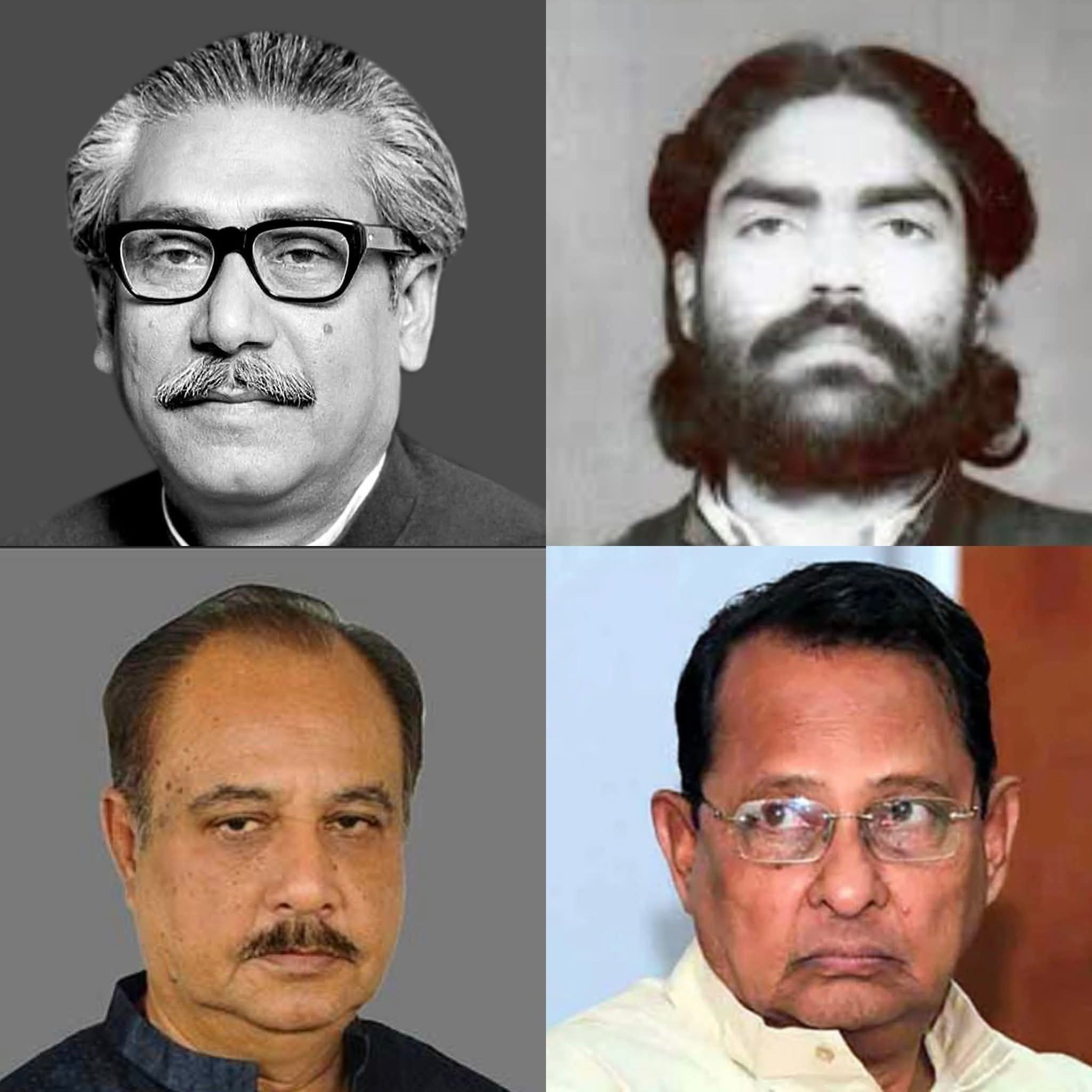
Mohammad Basir-Ul-Haq Sinha : Within the first 25 months of independence, Sheikh Mujibur Rahman’s government stood accused of limitless corruption and the wholesale institutionalisation of nepotism. Eighty-six per cent of industries were nationalised – a policy that swiftly became a licence for party loyalists to plunder the nation’s assets.

When Tajuddin Ahmad, then finance minister at the time, formally complained about the corruption of Gazi Golam Mostafa, the head of the Red Cross, and the systematic looting by party cadres, Mujib dismissed the concerns as “natural.” He offered his followers something close to absolution by describing them as “homeless urchins” – ghorchaara chhele – a characterization that served as tacit permission for their predation.
By 1974, famine had claimed anywhere between one million and 1.5 million lives. The government’s official press note put the figure at a grotesque 27,000. Amartya Sen, the Nobel laureate economist, later proved that foodgrain availability that year was actually higher than in other years. The catastrophe, he showed, was not a scarcity of rice but a scarcity of conscience: administrative collapse compounded by criminal hoarding.

In 1972, a maund of rice cost 71 taka. By early 1975, it had soared to 330 taka. A maund of mustard oil went from 12 taka to 41. The arithmetic of hunger was remaking the country.

It was against this backdrop that, on 10 February 1974, the JSD (জাতীয় সমাজতান্ত্রিক দল – National Socialist Party) unveiled its historic 29-point programme. Its demands included the removal of corrupt ministers and officials, the abolition of the infamous Jatiya Rakkhibahini (National Guard), the overhaul of the rationing system, and the release of political prisoners. The government was given until 15 March. It was ignored.
On 17 March, after a JSD rally at Paltan, a vast procession led by Major (Retired) M A Jalil, the party president, and ASM Abdur Rab, the general secretary, marched to the Ramna residence of Captain Mansur Ali, then home minister. The minister was elsewhere, at a public meeting in Keraniganj.
As the crowd waited at the gate to hand over a memorandum, several trucks carrying police and Rakkhi Bahini personnel arrived.
Major General (Retired) Khalilur Rahman, then director general of the Bangladesh Rifles, later described what happened next: “A young and reckless Rakkhi Bahini leader got out of a jeep and, machine gun in hand, opened fire directly into the crowd. Although JSD leader Hasanul Haq Inu ordered everyone to lie flat, the Rakkhi Bahini fired parallel to the ground, ensuring maximum casualties.”
Moinuddin Khan Badal, an eyewitness and organizer of the march, watched as bullets rained down on the bodies of those who had come to protest.
Among those killed instantly were Mukul, a female student of Eden College, and Jahangir, a JSD Chhatra League leader. Also dead were Zafar, a student of BM College in Barisal; Mafizullah, a worker at the Wapda electricity board; and Pradeep Chandra Pal.
The JSD claimed that at least 50 of its activists were killed that day.
The truth was worse. Ahmadullah Khan, then DSP of Tejgaon zone, later told his son – the JSD leader Moinuddin Khan Badal – that the Rakkhi Bahini had removed between 40 and 50 bodies from the scene in trucks and secretly disposed of them.
That same night, the government moved to bury the story. It raided the office of JSD’s daily newspaper, ‘দৈনিক গণকণ্ঠ’ (Daily People’s Voice). The editor of the newspaper, Al Mahmud – country’s most celebrated poet – was arrested from his home. Publication was permanently shut down. Months later, the constitution was amended to grant the Rakkhi Bahini full immunity: Article 16A made it impossible to bring any case against the force in court.
The carnage of 17 March was not merely a massacre. It was the first bloody step towards the abolition of multiparty democracy and the imposition of one-party rule under Baksal. These are not footnotes. They are the scars history refuses to let fade.
Sources : Mohiuddin Ahmad, জাসদের উত্থান পতন: অস্থির সময়ের রাজনীতি (The Rise and Fall of JSD: Politics in Turbulent Times), Major General (Retired) Khalilur Rahman, *Bela-Abela Bangladesh 1972–75* Amartya Sen, Development as Freedom (on the 1974 famine), Contemporary newspaper reports and police records, Dated: 24 March 2026_