
Staff Reporter : Last Thursday, after twenty years, the BNP announced the budget for the new fiscal year in the National Parliament. At a time when the country’s economy is in a deep crisis, especially due to the one and a half years of misgovernance by the Yunus government, which led to increased poverty, stalled investments, alarming unemployment, and extreme disruption to public life from high inflation, everyone was looking toward this budget. The proposed budget has inspired some hope among the public. In particular, extensive plans have been undertaken in the proposed budget to create new employment, establish an investment-friendly environment, and develop the private sector. To cure any disease, the first step is diagnosis. The finance minister has accurately identified the causes of the economic crisis in the budget. Moreover, the steps he plans to take to remedy this illness are also correct. He has rightly realised that to pull the economy out of the ruins, the private sector must be revitalised. The budget excellently highlights that the frustrated, multi-problem-stricken private sector is the key to overcoming the economic crisis. The primary goals of this budget are to create opportunities for youth to become entrepreneurs, gain employment, and generate income through planned industrialisation, export diversification, and the expansion of technology-based economic activities. The finance minister has set a target to foster a transparent, simple, and cost-effective business-friendly environment by relaxing regulations or legal controls to eliminate bureaucratic red tape and unnecessary delays. This budget emphasises restoring depositors’ confidence and accountability by ensuring discipline, transparency, and accountability in the banking and financial sectors. Additionally, it aims to encourage investment through capital market reforms.

Overall, the 2026-27 budget can be considered business and investment-friendly. A long-standing demand of businesses has been met by treating source tax as advance tax. The reduction of source tax on industrial raw materials to 4%, a 0.5% source tax on 60 essential commodities, the advance declaration of a five-year tax structure, and tax exemptions in healthcare, renewable energy, and electric vehicle sectors are commendable. Expanding the tax net without increasing the VAT rate and introducing provisions for quarterly online VAT returns are highly timely initiatives. Under Bangladesh Bank’s Tk60,000 crore stimulus package, the allocation of Tk5,000 crore for the CMSME sector is praiseworthy. Key initiatives like making turnovers up to Tk50 lakh tax-free for SME entrepreneurs and up to Tk70 lakh for women and disabled entrepreneurs, alongside introducing e-loans up to Tk50,000, are commendable. Flat-rate turnover taxes and separate VAT return forms for small businesses will simplify tax management. Finance and Planning Minister Amir Khosru Mahmud Chowdhury announced a plan to create over 2.5 million new jobs in the proposed budget.
If this budget can be implemented correctly, Bangladesh’s economy will turn around. However, bureaucratic hurdles and clearing the litter of the past will be the primary challenges. To implement this budget, the confidence of businesses must be restored.
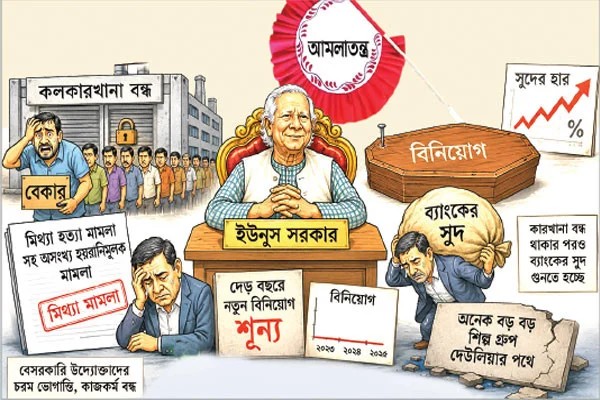
During the tenure of the Yunus government, thousands of factories were shut down. Through mob violence, numerous factories were looted and set on fire under state patronage. Millions of workers became unemployed in an instant under the Yunus government. Private entrepreneurs were subjected to extreme harassment through false murder cases and countless vexatious lawsuits. The situation escalated to a point where they ceased operations. No new investments took place during the one and a half years of the Yunus government. The governor appointed by the Yunus government drove the final nail into the coffin of investment by raising interest rates on bank loans. The primary objective of the Yunus government seemed to be bankrupting Bangladesh and binding it in the chains of foreign slavery. During this period, many large industrial groups in the country came to the brink of bankruptcy. Even though their factories remain closed, many still have to count bank interests.

During the 18 months of the Yunus government, all types of new investment proposals were shelved. Businessmen and industrial entrepreneurs are riddled with frustration. The private sector is trapped in a dark tunnel. Therefore, to implement the proposed budget, the litter left behind by Yunus must be cleared first. In today’s era of globalisation, industrial entrepreneurs must maintain regular contact with foreign counterparts and travel abroad to boost investment and exports. The Yunus government, to satisfy its political vendetta, unjustly imposed travel bans on many businessmen. Restricting foreign travel for 21 months without any reason is unprecedented. Although three months have passed since the current government assumed power, that ban has not yet been withdrawn. It appears that the current government has not shifted away from the flawed policies of the Yunus government; they, too, seem to be walking the same path. It is impossible to win the confidence of the private sector while keeping these investment-destroying measures of Yunus active.
To increase investment in the country and for economic development, this travel ban needs to be lifted immediately. To materialise the proposals made by the finance minister regarding investment and employment growth, it is crucial to eliminate these obstacles. A fear-free environment must be created in the private sector.

বিজ্ঞাপন
In this budget, the government has taken multi-faceted initiatives to stop bureaucratic complexities and harassment in the private sector. Applications for business registration, various approvals, clearances, and other public services must be settled within a maximum of one week. If the relevant government agency fails to provide an opinion or clearance within the specified timeframe, the application will be deemed automatically approved.
Company name clearance, registration applications, fee payments, and certificate issuance will be done entirely online, ensuring company registration within a maximum of 48 hours. An online-based provisional approval system will be introduced for small and new businesses, enabling entrepreneurs to start working quickly and complete the remaining registrations within the next 6 to 12 months. Furthermore, to ease local business operations, trade license services of City Corporations and Municipalities will be integrated into the central service system in phases.
These initiatives are highly critical and positive. However, past experience shows that due to bureaucratic red tape, implementing such initiatives becomes impossible. An industrial entrepreneur has to obtain multiple clearances from various places, moving from pillar to post. Even if a single clearance remains pending, the factory cannot start operations. Although existing laws also stipulate specific timeframes for obtaining these clearances, in reality, they are not received within the deadline. It takes years to secure all clearances. Consequently, entrepreneurs become loan defaulters right at the beginning. Entrepreneurs have to run from office to office for days just to secure clearances, having to practically beg for favours from various government agencies. Officials at some clearance-issuing institutions behave in a manner that makes it seem as though setting up an industrial factory in this country is a crime.
Harassment at land offices, suffering for electricity, and not getting gas connections despite paying security deposits seem to be the destiny of industrial entrepreneurs in this country. Thus, obstacles are faced at every step just to set up a factory. Businessmen appear to be dependent on the mercy of government institutions. This state of affairs needs to change. It is necessary to monitor whether field-level bureaucrats and administration officials are adhering to the budget directives.
Take the example of waste removal after Eid-ul-Azha. The officials in charge of the field made grand promises. However, Prime Minister Tarique Rahman did not sit idle relying on their assurances; he went out to personally inspect the waste removal operations. He observed that reality did not match the smooth words of the officials. He took immediate action against several individuals. This was an extraordinary step by the Prime Minister. To boost investment, such field inspections are essential. Bureaucratic hurdles can be eliminated if there is regular monitoring to ensure whether the deadlines set by the government for issuing various licenses and clearances are being effectively implemented at the field level. The Prime Minister’s example could be followed in this regard.
The private sector must be considered a partner of the government in implementing the budget. To tackle the current economic crisis, the government and the private sector must work hand in hand. For that, it is necessary to take private entrepreneurs into confidence and eliminate the environment of fear that the Yunus government had created in the private sector. Alongside this, an investment-friendly administrative management system is required. The budget announced by the finance minister can become a milestone in Bangladesh’s economic development if it can be successfully implemented. And for the implementation of this budget, it is imperative to eliminate all obstacles and create a business-friendly environment.