
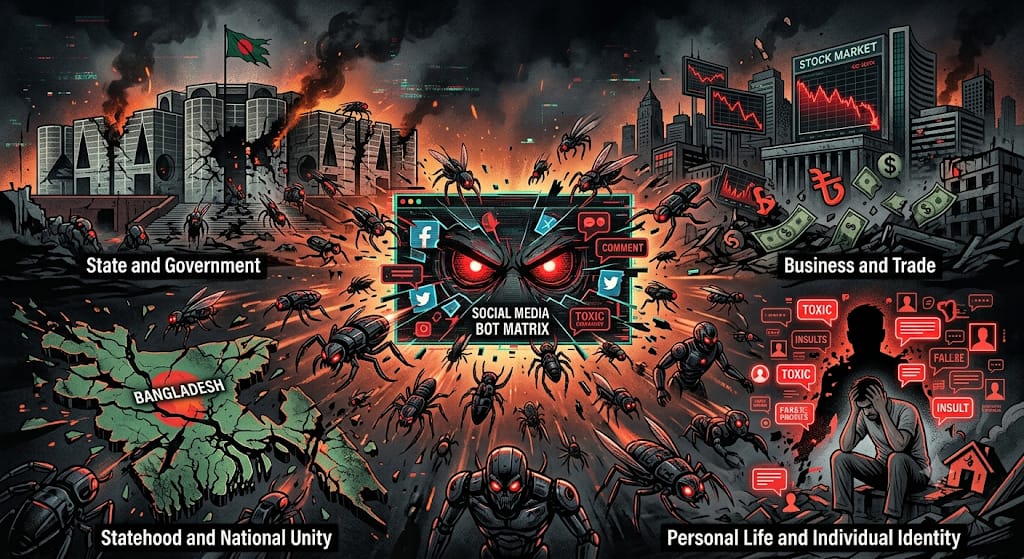
Staff Reporter : What is the biggest challenge for Bangladesh at this moment? In response, many would say tackling the economic crisis, while others might point to improving the law-and-order situation. However, a new threat is brewing entirely unnoticed by most of us. We feel this threat every single moment; this new menace is making our state, social, and family lives miserable, yet we cannot find a way out of this crisis. We are accepting it as destiny. We are talking about the “bot force” on social media.
With the accessibility of the internet and smartphones, the number of social media users in Bangladesh has increased significantly over the past decade. This digital world is no longer just a space for freedom of expression; it has turned into a new battlefield for exerting political influence, manufacturing public opinion, trade wars—and even character assassination. Recently, at an event, the Prime Minister’s Adviser on Posts,
Telecommunications, and Information Technology, Rehan Asif Asad, claimed that 60 to 70 percent of the country’s total cyber traffic consists of bots or automated activities. He stated that analyzing cyberbullying or online reactions without understanding this reality carries the risk of reaching flawed conclusions. Citing data from recent online traffic analyses, Rehan Asif Asad said that a major portion of online comments, reactions, and interactions do not come from real users. It is difficult to identify the root of the problem without separating organic traffic from non-organic traffic.
This bot forces has now become so powerful that they are attacking important state figures. They are manufacturing fake public opinion against the government’s crucial and well-intentioned decisions. By running planned smear campaigns against any reputable individual, they are destroying their image. They are endangering the lives of women by demeaning them. They are not very large in number, but by using information technology, they create an ethereal, loyal force in their favor—whose members are not people, but bots or robots.
What actually is a bot ? The word “bot” is derived from “robot.” It is essentially a software program designed to automatically mimic human behavior on the internet. When thousands or hundreds of thousands of fake profiles are used for a specific purpose, it is called a “bot force”Examples include cyberbullying a specific individual, spreading propaganda, or praising someone.
They are primarily of two types: automated bots and human troll forces.Automated or robotic bots are entirely computer-driven. They automatically comment whenever they detect a specific keyword. For instance, if you post mentioning a specific person or country, the programmed bots will instantly arrive and paste pre-set comments. Currently, bots equipped with Artificial Intelligence (AI) are even more dangerous. Instead of just copying and pasting, they can write contextually relevant and distinct comments just like a human. On the other hand, a “human troll force”consists of actual humans operating via fake IDs. They are hired for money or political motives. A single person might control 10 to 20 IDs, and the moment they receive instructions, they flock to a specific link to attack in groups. Though technologically they are not bots, they are commonly known as a bot force to the general public.
A bot force generally operates using three strategies : Controlling Narratives- First, after an incident occurs, they try to dictate the direction of public opinion. By flooding a post with hundreds of positive or negative comments, they attempt to manipulate the thought process of ordinary people.
Character Assassination-Second, they are unleashed to defame a specific individual or institution. When thousands of fake IDs use identical language to hurl insults or slander, ordinary people might mistake it for the truth.
Mass Reporting- Third, they launch mass reports simultaneously to shut down a page or an ID. Consequently, the algorithms of Facebook or other platforms get confused and automatically block the account. In the terminology of Meta or Facebook, this type of activity is called, Coordinated Inauthentic Behavior (CIB).
How to Identify a bot ? There are some professional ways to detect bots. For instance, if 100 or more comments appear within just 5 seconds of a news article or post being published, it is clearly the work of bots. It is impossible for a flesh-and-blood human to read and comment so quickly. Similarly, if the comments of 10 to 15 different accounts are completely identical, it is a bot’s doing. Furthermore, bot accounts usually lack any personal life or real identity. Their profile pictures feature celebrities, flowers, or birds. Their timelines consist entirely of shared posts rather than original ones, and their follower counts or friend lists look highly unusual.
Threat to the country : The bot force is now a major threat to democracy. They can present truth as falsehood and falsehood as truth. They can deliberately court controversy over the government’s good decisions. They can distort the words of responsible government officials to humiliate them before the public. Following a political event, movement, or sensitive news release, thousands of identical comments, matching language, and the same tone of propaganda instantly flood the platform. This leads many ordinary users to believe that the entire society has taken a stand in favor of a specific opinion. In reality, the lion’s share of this wave of public opinion is artificial.
They are unleashed to tarnish the reputation of specific individuals or organisations. When thousands of fake IDs insult and slander using the same language, ordinary people often get confused and believe it to be true. This is often termed, Information Warfare, Since digital media literacy and the culture of fact-checking are still weak in our society, bot-driven propaganda can easily exploit people’s emotions, political beliefs, and social divisions.
The true strength of this bot is not just technology, but human psychology. When hundreds of identical comments appear on social media, ordinary users get the impression that this might be the majority opinion. In psychology, this is called the “Bandwagon Effect.”In political communication, it is known as “Astroturfing”-meaning, artificially creating an environment to make it seem like spontaneous public opinion. In reality, it is a form of digital deception. Even before a mob is formed against a person, the groundwork of making them controversial or targets for violence on social media is carried out using bots.
Dominance of bot forces in Bangladesh : This strategy is now being widely used in the political culture of Bangladesh. In many cases, deepfakes or misleading content are created first, and then bots are utilised to make them look credible. As a result, the boundary between truth and falsehood is becoming increasingly blurred. Social media is gradually turning into a space where propaganda is more influential than information. This bot culture is increasing toxicity in society, shrinking the environment for freedom of expression, and destroying people’s trust in information.
Democracy does not stand on votes alone; it stands on free expression, truthful information, and conscious citizens. Just as strikes, violence, or suppressing the opposition’s voice are detrimental to democracy, this digital culture of creating artificial public opinion is equally dangerous. This is because it manipulates human independent thinking and seeks to establish confusion as an alternative to the truth.
A few urgent steps are necessary to tackle this crisis: : Platform Accountability: First, tech companies, including Meta and Google, must enhance their capacity to understand the Bengali language and local context. Bangladesh needs to immediately sign agreements with all social media platforms, including Meta and Google. Necessary steps must be taken to ensure they set up local offices in Bangladesh, bringing these institutions under accountability.
Legal Framework: Second, effective legal action must be taken against organised digital propaganda and troll farms. Such laws need to be enacted immediately; otherwise, democracy will be weakened, causing the greatest damage. If the means of gauging true public opinion are obstructed, the rule of law and justice will collapse.
Digital Literacy: Most importantly, digital media literacy must be prioritised. Education on information verification, critical thinking, and responsible online behavior must be provided starting from schools and colleges.
The government must decide right now: will the free flow of information for the citizens be ensured in this country, or will the right to information remain held hostage by the bot force?