
Staff Reporter : Bangladeshis can be found in the unlikeliest of places in search of gainful ’employment’. Recently two Bangladeshi militants were killed, reportedly in an anti-militancy raid in Pakistan. Two Bangladeshis were also found in the Ukraine war fighting in support of Russia as mercenaries. With financing and patronage, Bangladesh with a vast population of poor devout Muslims can potentially become an unlimited source of Islamic militants and suicide bombers for the rest of the world.
Is Bangladesh at a crossroads, moving from a tolerant, non-communal, liberal, Muslim-majority society toward a communal Islamist state? This question now worries many conscious citizens inside the country and has created unease among international stakeholders with interests in Bangladesh.
From Student Movement To Mass Uprising
The July 24 mass movement began with student protests around July 1, 2024, calling for reforms to the government job quota system. What started as a sectoral demand quickly turned into a nationwide uprising against systemic discrimination under the then-ruling Bangladesh Awami League (BAL). People from all walks of life—regardless of age, socio-economic status, or political affiliation—joined the movement. Remarkably, participants remained non-violent, confining themselves to resisting armed aggression.
On August 5, 2024, the movement culminated in the fall of the Awami League government.

An interim government (IG) was formed thereafter. The Head of Government publicly declared the movement’s student leaders as the “appointing authority” and guardians of the new administration. Several were inducted into the cabinet, while others were placed in powerful advisory or supervisory roles across ministries. In effect, a segment of the movement’s young activists became the de facto guardian body of the state. The Head of Government even described the movement as “meticulously designed.”

বিজ্ঞাপন
The IG and its young leadership began framing anyone prosecuted by what they labeled the “fascist Hasina regime” as patriots—while branding almost everyone else as complicit.
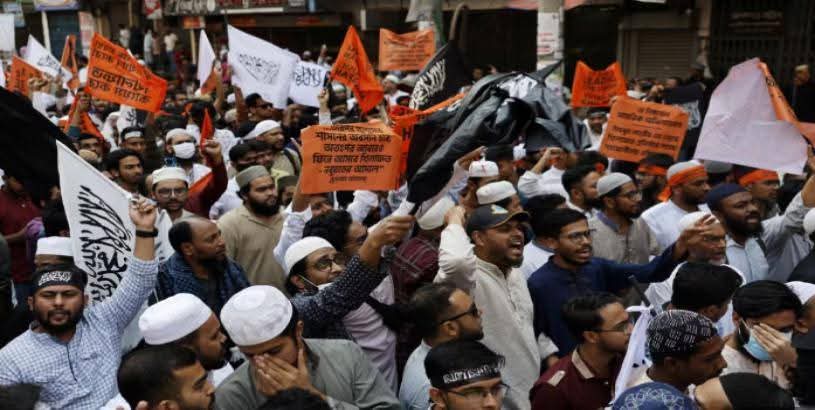
Militant Groups Find Opening Islamist militant organizations had long borne the brunt of Hasina’s security crackdowns; they were among her fiercest opponents. Reports now suggest that these groups played a significant role in the regime’s downfall, with some openly admitting involvement in violent acts and sabotage during the uprising. Many of them publicly advocated creating an Islamic state by rewriting the constitution and erasing elements of Bangladesh’s history, culture, and heritage.
During and after the uprising, walls across Dhaka and other cities were covered with slogans, Arabic inscriptions, and flags resembling those of Hizb ut-Tahrir and the Islamic State.
Movement leaders appeared to share a sense of solidarity with these groups, united in the goal of toppling the BAL government and establishing an Islamic-leaning political order. Militant elements were seen as “patriots” and allowed to operate openly—until US
Intelligence Chief Tulsi Gabbard raised alarms about rising militancy in Bangladesh. This was followed by a New York Times report on April 1, 2025: “As Bangladesh Reinvents Itself, Islamic Hardliners See an Opening.” Under mounting global scrutiny, the IG curtailed their public visibility, though their activities continued under new guises.
Push For New State Structure The people who joined the anti-discrimination movement sought fair elections, accountability, and a discrimination-free society. But the movement’s coordinators extended their goals far beyond electoral reforms. They spoke of creating an entirely new state structure—one echoing communal politics from the Pakistan era. Their rhetoric portrayed Bangladesh’s liberation struggle as a foreign conspiracy, dismissed freedom fighters as traitors, and framed the country’s independence as a historical mistake.
It is now clear that Jamaat-e-Islami (JI) and its student wing, Islami Chhatra Shibir (ICS), were deeply embedded in the movement. They were present within student groups, among coordinators, and among the movement’s foot soldiers.
The backgrounds of many coordinators reveal an upbringing steeped in Islamist ideology, with covert links to Jamaat-Shibir networks. JI Naib-e-Ameer Syed Abdullah Mohammad Taher admitted in a BBC Bangla interview: “We played a fundamental role and were very cautious to ensure that it was not revealed as a Jamaat-Shibir movement. We wanted to give it a universal appearance.”
This suggests JI acted as a parent body for the Interim Government-backed National Citizens Party (NCP) and various militant groups linked to the agitation.
Movement leaders also demanded justice for past crimes against humanity and structural reforms aligned with their ideological goals. To realize these aims, communal and militant forces under JI now appear determined to capture state power—either directly or through elections engineered to their advantage.
Engineering Electoral Path To Power
The IG has fractured the national unity forged during the uprising, dividing the political landscape into two clear camps: • liberal and centrist parties with broader public support, and • conservative or hardline Islamist factions.
Liberal forces are now branded “fascist collaborators” and denied political and even basic human rights.
On May 12, 2025, the Awami League’s activities were banned by administrative order. JI and its allies are reportedly planning to ban the Jatiyo Party (JP) and the 14-party alliance. Even if permitted to contest, JP faces a hostile environment, with government-backed obstruction, violence, and uneven playing conditions.
A political system is emerging in which elections would effectively be a contest between JI and its allies—backed by the IG—and the Bangladesh Nationalist Party (BNP). Yet, based on past voting patterns, these two groups together represent barely half the electorate.
There are widespread reports of JI spending large sums to buy votes and using trained cadres to intimidate opponents. Analysts claim JI, with IG support, now controls key state institutions, including law enforcement, administration, the judiciary, and election-related bodies.
JI central committee member Shahjahan Chowdhury said at a meeting in Chattogram on November 22, 2025: “The election will not be decided by the people alone. In every constituency, we must bring the entire administration under our influence. They will stand when we say, sit when we say, arrest when we say, and file cases at our command.”
He added: “The police must walk behind you. The OC should ask about your daily schedule and provide protocol.”
A recent International Republican Institute (IRI) survey shows that if elections were held next week, BNP would receive 30% of votes and JI 26%. The poll also indicates that 53% of respondents view JI favorably, slightly more than BNP’s 51%. Meanwhile, 7% remain undecided, and 11% declined to disclose their preference.
Many analysts believe that without the participation of BAL, the 14-party alliance, and JP, JI and its militant allies could capture state power through a one-sided election.
Why Islamist Takeover Is Dangerous
Bangladesh is a densely populated, resource-scarce country of 170 million, with about 90% Muslims. Fertile land is its primary asset. According to the World Bank, 39 million people live below the poverty line, including 15.8 million in extreme poverty. Job opportunities are limited; unemployment remains high. Hundreds of thousands risk their lives each year to find work abroad, often through perilous illegal routes.
Bangladeshis are now found in unlikely and dangerous conflict zones. Recently, two Bangladeshi militants were killed in an anti-terror raid in Pakistan. Two others were discovered fighting as Russian-aligned mercenaries in Ukraine—one died, the other survived.
With financing and ideological patronage, Bangladesh’s vast population of economically vulnerable, deeply religious youth could become a limitless recruitment pool for militant networks. If communal Islamist forces and militant groups manage to ascend to state power, this is not just a possibility—it could become a global security nightmare.